This article may contain affiliate links. As an Amazon Associate, Purely Nurtured earns from qualifying purchases. We may also earn commissions through other affiliate programs at no additional cost to you. This content is provided for educational purposes only and is not medical advice.
Our favorite red lights for egg quality, IVF, TTC + male fertility, and exactly how to use them
You’ve probably heard great things about red light therapy for fertility. And if you’re here, you’re probably wondering the same things most women are: Which one should I get? Do men and women need different devices? And, perhaps most importantly, how do I actually use it?

You’ve come to the right place. We’ve been studying and talking about red light therapy for fertility with a huge audience of women for almost half a decade. Over the past four years alone, we’ve seen red light included in thousands of successful fertility journeys across our audience.
Although we can’t separate red light from the other parts of various protocols and say it caused those positive outcomes, after years of watching women successfully incorporate it into their fertility routines — all while the research continues to grow — it’s a fertility adjunct we genuinely love.
So, by very popular request, we’re making this easy. First, we’ll show you exactly what we’d buy. Then we’ll explain why, how we use it, and the research behind our choices.
Please do not spend thousands of dollars on a “fertility laser.”
You do not need a $4,000 laser, repeated expensive laser-clinic visits, a wildly overpriced fertility-branded light, or a $100+ “personalized” red-light protocol. We grimace when we see this happen because fertility is expensive enough.
Shop Our Fertility Red Light Edit
BEST FOR HER
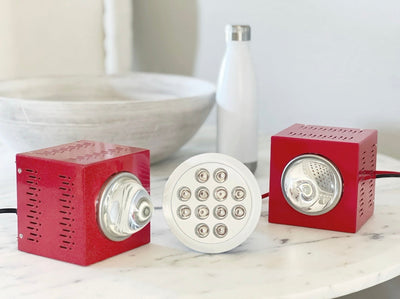
Red Light Man Infrared 830
If a woman asked us which red light we’d buy specifically for fertility, this is it.
Why we love it: A strong, targeted 830-nm near-infrared device using the wavelength we prefer for female fertility. Best for: Egg-quality support, TTC and IVF preparation.
Wavelength: 830 nm near-infrared. Our take: This is our first recommendation for most women. How to use it: Our exact protocol is below.
SHOP THE INFRARED 830 →
Fast + free worldwide shipping.
Use our link + code PURELYNURTURED to get a stacking discount.

BEST BUDGET
Red Light Man Infrared Mini 830
The smaller, lighter and less-expensive way to get the 830-nm wavelength we prefer.
Why we love it: Same wavelength strategy in a much smaller device. Best for: Women who want to spend less or find the full-sized Infrared 830 too heavy to hold comfortably. We’ve heard this from a surprising number of women with wrist-strength issues, so it’s worth mentioning.
Wavelength: 830 nm near-infrared. Our take: Our favorite lower-cost option.
SHOP THE INFRARED MINI 830 →
Fast + free worldwide shipping.
Use our link + code PURELYNURTURED to get a stacking discount.

BEST FULL-SIZE PANEL
Red Light Man Infrared Bodylight 830
If you want to go all-in, this is our favorite splurge.
The Bodylight is a full-size panel using 100% 830-nm near-infrared, with 200 high-powered LEDs and substantially broader coverage than the smaller targeted devices.
For fertility, that size and power are not just about convenience. The Bodylight can expose the entire lower-abdominal and pelvic region at once, delivering substantially more total 830-nm light across a much larger area without relying on repeated repositioning of a handheld device. That makes it our strongest, broadest 830-nm setup for female fertility among the devices we recommend, while also giving you a true full-body PBM system for everything else you want to use it for.
Best for: Someone who wants maximum 830-nm coverage and output for fertility, plus a serious full-body PBM setup.
SHOP THE INFRARED BODYLIGHT 830 →
Fast + free worldwide shipping.
Use our link + code PURELYNURTURED to get a stacking discount.

BEST FOR COUPLES
MitoPRO+ Series
If you want one system for both of you, this is our favorite shared option.
Why we love it: The MitoPRO+ lets you choose red only, near-infrared only, or red + NIR together, using 630/660-nm red light and 830/850-nm NIR. That flexibility matters because male and female fertility call for different PBM approaches.
She can use NIR or red + NIR according to the female protocol, while he can select red only.
Best for: A couple who wants one device that can accommodate both fertility protocols.
SHOP MITOPRO+ →
Mito Red Light discount: After clicking the link, be sure to select Redeem Now in the pop-up window to activate your discount before shopping.

BEST FOR HIM
Red Light Man Red Mini 670
For a dedicated male-fertility light, this remains our favorite.
Why we love it: We use visible red light around 670 nm for male fertility rather than the deeper NIR approach we use for women. The testes are external reproductive organs and sperm production is temperature-sensitive, so for him we want red light without warming the testes.
Best for: Male fertility. Wavelength: 670 nm red. Exact protocol: below.
SHOP RED MINI 670 →
Fast + free worldwide shipping.
Use our link + code PURELYNURTURED to get a stacking discount.

BEST FOR TRAVEL
MitoPRO Mobile
If fertility treatment takes you on the road, this is our travel pick.
The MitoPRO Mobile is a compact, battery-powered device with 630, 660, 810, 830 and 850 nm, a built-in stand, hand strap and its own travel case. It weighs about 1.5 pounds and runs approximately 2.5–3 hours per charge.
That makes it genuinely practical for IVF trips, extended clinic stays and vacations where dragging a full panel along isn't realistic.
SHOP MITOPRO MOBILE →
Mito Red Light discount: After clicking the link, be sure to select Redeem Now in the pop-up window to activate your discount before shopping.

Can Red Light Help Egg Quality?
For many women, this is the whole reason we’re here. It’s also one of the biggest reasons we’ve remained interested in photobiomodulation for fertility.
An egg has an extraordinary job to do. An oocyte has to grow and mature, correctly organize and separate its chromosomes, complete meiosis, be fertilized and then help support the rapid cellular activity of early embryo development. All of those are highly energy-demanding processes.
It Starts With the Cell
You may have heard red light described as helping to “charge” your mitochondria. That’s a simplified but useful way of understanding why photobiomodulation became so interesting in fertility.
Mitochondria produce ATP, the usable energy cells need to function. Mitochondrial health is particularly important in oocytes, and mitochondrial dysfunction is associated with reproductive aging. Photobiomodulation can influence mitochondrial and cellular processes involved in energy production, including pathways related to cytochrome c oxidase, ATP, nitric-oxide signaling and redox signaling.¹
The interest also extends beyond cellular energy. PBM has been studied throughout the body for effects involving circulation, oxidative stress, inflammatory signaling and tissue function.
Put that together with the extraordinary energy demands of an egg and the importance of mitochondrial function in reproductive aging, and it becomes easy to understand why researchers began exploring PBM for fertility.
Is red light worth considering as part of an egg-quality routine? We think so.
Why We Choose 830 nm for Women

If we're buying a red-light device specifically for female fertility, we choose 830-nm near-infrared.
For us, the answer is pretty simple.
First, we're trying to reach the ovaries and uterus inside the pelvis, not a superficial skin target. Near-infrared wavelengths are used specifically when deeper tissue penetration is desirable.
Second, 830 nm has direct human fertility precedent. Toshio Ohshiro and colleagues used 830-nm GaAlAs photobiomodulation in severely infertile women in Japan. In an initial group of 74 women, 16 became pregnant and 11 delivered babies. Their larger clinical experience ultimately included 701 women, with 156 pregnancies and 79 live deliveries reported.²
Third, 830 nm is a well-established near-infrared PBM wavelength and is available in powerful home LED devices at reasonable prices.
Finally, after years of recommending 830-nm red light for female fertility, we’ve received overwhelmingly positive feedback across our audience of thousands of women. That real-world experience is a major reason 830 remains our preferred wavelength when someone is buying specifically for female fertility.
For us, the answer is simple:
Buying specifically for female fertility? Get the 830.
The Fertility Research Keeps Getting More Interesting
The Ohshiro work remains one of the most interesting pieces of human fertility-PBM research because it involved actual pregnancies and births following an 830-nm fertility protocol.²
The paper also includes fascinating thermal images showing changes in peripheral temperature and circulation while PBM was applied to specific areas around the neck.
SEE THE ORIGINAL STUDY + THERMAL IMAGES →
And research continues to evolve. More recent studies have reported encouraging effects of PBM on ovarian aging, mitochondrial function, oxidative stress and inflammation in reproductive-aging models,⁴ while a 2026 study also included a human pilot in women with diminished ovarian reserve in which median AFC increased from 2 to 6 after treatment.³
Fertility-specific PBM research continues to grow, alongside the much larger body of research on photobiomodulation throughout the body.
How We Use Red Light for Female Fertility

This is where fertility red light should become wonderfully uncomplicated. Our preferred female schedule is daily use. Over the years, we’ve received considerably better feedback from our audience with daily use than with the every-other-day approach we experimented with previously. Nothing is mandatory, but if you’re asking what we prefer, it’s daily.
The Basic Routine
We start with an empty bladder and use the light on clean, bare skin rather than through clothing which blocks the light. For the Red Light Man handheld devices, we position the light directly against or very close to the skin while comfortable. We take advantage of that great time before the light becomes warm.
For most women, the uterus and ovaries are close enough together that the general lower-abdominal and pelvic region can be covered efficiently. With the full-sized Infrared 830, our typical routine is about 15 minutes total over the uterus + ovaries. You can reposition it for roughly 4–5 minutes over each area if you prefer, but we don’t see a need to turn this into an hour-long ritual.
We also include the neck. The foundational Ohshiro work incorporated light around the neck as part of the Proximal Priority Theory, and we’ve included neck PBM in our fertility approach for years.² We target the left side of the neck (left carotid artery,) right side of the neck (right carotid artery,) and the nape/back of the neck (vertebral artery) from a distance of 8" or so. This is also why the thermal images in Ohshiro’s fertility paper are so interesting: neck exposure was associated with visible changes in peripheral circulation.
Part of the rationale for including the neck is the brain. Ohshiro’s Proximal Priority approach targets areas around the major arteries supplying the brain, with the goal of supporting cerebral blood flow and systemic PBM effects. Because the brain is extraordinarily energy-demanding, and plays a central role in reproductive hormone signaling, supporting blood flow and cellular energy metabolism there is one reason we continue to include the neck in our fertility protocol.
Adjusting the Routine for Your Device
Times given are minimums.
With the Infrared 830, use approximately 15 minutes total over the uterus + ovaries, directly against or very close to the skin, and include the neck areas for about 4-5 minutes each.
The Infrared Mini 830 follows the same basic routine, but because it covers a smaller area, we generally use it for about 15–20 minutes total and reposition it a little more. Here we include the neck areas for about 6-8 minutes each.
The Infrared Bodylight 830 is the powerhouse option. It can expose the entire lower-abdominal and pelvic region at once with substantially more total 830-nm light across a much larger area. We position it relatively close for strong pelvic exposure for about 20 minutes rather than buying a panel this powerful only to stand several feet away from it. If you want to go all-in, this is the one.
With the MitoPRO+, women can select either NIR only (830 + 850 nm) or red + NIR together and use it over the lower-abdominal/pelvic region for roughly 15–20 minutes, while also including the neck areas for about 5 minutes each.
For Red Light Man, use the links + code PURELYNURTURED for a stacking discount.
For Mito Red Light, click our link and then select Redeem Now in the pop-up window to activate the discount before shopping.
One thing that surprises almost everyone:
830-nm near-infrared light is nearly invisible. Your device may produce only a faint reddish or purplish glow even when it’s working normally. And if any device becomes uncomfortably warm against your skin, pull it slightly farther away. We’re after the light, not heat. Use a timer, too, especially if you find red-light sessions relaxing enough that you could accidentally fall asleep.
Red Light for IVF + FET: When to Start and Stop
If you have three months before retrieval, wonderful. If you have longer, wonderful. Follicles develop over an extended period, so starting earlier gives PBM more opportunity to overlap with follicular development.
But our practical rule is much simpler: some is better than none. If you have six weeks, use six weeks. If you have three weeks, use three weeks. If you only have a couple days left, use it for FET. We also think incorporating red light during retrieval preparation itself can be worthwhile; years of feedback across our audience have kept retrieval cycles high on the list of reasons women use fertility red light.
So don't think that a retrieval next month or even next week makes starting pointless. Start where you are.
What About FET?
FET is a little different because the embryo already exists. At that point, the focus shifts away from egg-quality support and toward the uterine environment, circulation and endometrial preparation. Some of the most encouraging feedback we’ve received has come from women incorporating red light into their transfer preparation, and we’ve seen it used successfully in a variety of ways. If you only have your FET left, we would still start.
When Do I Stop?
Our longstanding reference point has been positive pregnancy test, based on guidance from well-regarded reproductive endocrinologist with extensive experience researching fertility PBM. Some women prefer to stop earlier, whether around stimulation, retrieval, ovulation or embryo transfer. Whatever you and your doctor are most comfortable with is fine. We’ve seen many successful journeys with different stopping points.
If you’re undergoing fertility treatment, this is an easy place to personalize the routine around your own plan and comfort level.
Red Light for Male Fertility

Male fertility is one of the areas where PBM research is especially interesting. Human sperm studies have repeatedly reported improvements in motility after PBM exposure. One study in men with asthenozoospermia found a significant increase in progressive sperm after a single exposure,⁸ while another LED study reported increases in rapidly progressive sperm and reductions in immotile sperm.¹¹ Another experiment reported sperm-motility increases of up to several-fold under certain conditions, with the response varying by dose.⁹ A systematic review likewise found consistently encouraging effects on progressive motility across the included effectiveness studies.¹⁰
The sperm research is encouraging, and our home approach is very simple.
For targeted male use, we prefer 670-nm visible red light with the Red Light Man Red Mini 670. We prefer to use it over bare testes from approximately 12 inches away for about 2 minutes, every other day.
The most important rule is no heat. We choose visible 670-nm red partly because we don’t need the same deeper-penetrating NIR approach we prefer for female fertility, but especially because the testes are temperature-sensitive. If warmth is noticeable at 12 inches, move the device farther away. The goal is light exposure, not warming the testes.
If you’re sharing a MitoPRO+, select red-only mode for him and use enough distance to avoid perceptible warming. Because the MitoPRO+ is a much larger panel, don’t automatically copy the distance used with the small Red Mini 670.
Why We Prefer LEDs Over Expensive Fertility Lasers
If you’ve been researching fertility red light for a while, you’ve probably encountered the term LLLT: low-level laser therapy. That terminology is long outdated. In 2015, leaders in the field recommended photobiomodulation therapy, or PBM, as the new, more accurate term because evidence showed that the biological effects were not limited to lasers, as was previously and erroneously believed.⁵ In fact, there is a popular adage in PBM: “a photon is a photon," that illustrates the concept that a photon does not know whether it came from a laser or an LED.
NASA Helped Establish High-Powered LEDs as Serious PBM Technology
NASA played an important role in advancing the therapeutic use of high-intensity red and near-infrared LED arrays. Beginning in the 1990s, NASA’s Marshall Space Flight Center funded research into medical applications of LEDs, including their potential to support cell growth, wound healing, and muscle and bone health during long-duration spaceflight. Between 1995 and 2003, NASA-funded projects supported medical LED research involving Quantum Devices, the Medical College of Wisconsin and other collaborators.⁶ ⁷
So, You Mean I Don’t Have to Buy a $4,000 Fertility Laser?
No, we don’t think an expensive fertility laser is even remotely better. For home photobiomodulation, we strongly prefer LEDs. And our audience’s success stories speak for themselves. LEDs can be built into increasingly powerful devices and large arrays, used easily and repeatedly at home, and scaled from small targeted lights to full-body systems. Those advantages are a major reason the enormous modern red-light therapy industry has developed almost exclusively around LED technology.
And putting "Fertility" on the side of a red-light device doesn’t magically improve power or penetration. Your ovaries can't read the packaging.
There has never been a need to pay for a “personalized” fertility red-light protocol.
The same applies to expensive personalized or proprietary fertility-light protocols. You need to know which device to use, where to put it, and how long and often to use it. We’re giving you all of that right here.
No extra fee required.
Keep the thousands of dollars. You may need them for another part of fertility treatment. An effective fertility red-light setup does not need to cost anything close to $4,000. And instruction should be free.
The Bottom Line
We've been studying and talking about fertility red light for almost half a decade. In that time, we've seen it become part of thousands of successful fertility journeys across our audience. We still love it.

It's simple, easy to incorporate, doesn't need to be extremely expensive, and the fertility-specific research continues to grow.
If you're buying specifically for female fertility:
Get the 830.
It’s the wavelength we come back to again and again for female fertility, and the one we’d choose first for any dedicated at-home setup.
SHOP OUR #1 FERTILITY RED LIGHT →
Use our link + code PURELYNURTURED to get a stacking discount. Fast + free worldwide shipping.
SAVE YOUR QUICK GUIDE
Get the Purely Nurtured Fertility Red Light Quick Guide™ sent straight to your inbox so your wavelengths, placement, timing + device picks are easy to reference whenever you need them.
Important Disclaimer
This article describes our approach to red light therapy for fertility, based on published research and nearly half a decade of studying its use and hearing from women who have incorporated it into their fertility journeys.
While we have seen red light therapy included in thousands of successful fertility journeys across our audience, we cannot establish that red light caused those outcomes, and those experiences should not be interpreted as scientific proof or a guarantee that others will experience similar results.
The protocols and product recommendations shared here are for informational and educational purposes only and are not individualized medical advice. Everyone's fertility and health situation is unique. Please consult your healthcare provider about decisions regarding your own care, particularly if you are undergoing fertility treatment, are pregnant, or have a complicated medical or reproductive history.
Related Articles
- Photobiomodulation Explained: How Red + Near-Infrared Light Work
- Red Light Therapy Wavelengths Explained: Red vs. Near-Infrared Light
- How Mitochondria Affect Egg Quality + Ovarian Aging
- Red Light Therapy for Male Fertility + Sperm Health
- Red Light Therapy for FET + Endometrial Lining
- Red Light Therapy for PCOS
- Red Light Therapy for Endometriosis
- Our Complete Guide to Improving Egg Quality
References
1. de Freitas LF, Hamblin MR. Proposed Mechanisms of Photobiomodulation or Low-Level Light Therapy. IEEE Journal of Selected Topics in Quantum Electronics. 2016;22(3):7000417.
https://pubmed.ncbi.nlm.nih.gov/28070154/
2. Ohshiro T, et al. Personal Overview of the Application of LLLT in Severely Infertile Japanese Females. Laser Therapy. 2012.
https://pmc.ncbi.nlm.nih.gov/articles/PMC3944482/
3. 630 nm LED phototherapy enhances ovarian function and fertility potential in advanced reproductive age females. 2026.
https://pubmed.ncbi.nlm.nih.gov/42272970/
4. He Y, Ye R, Peng Y, et al. Photobiomodulation ameliorates ovarian aging by alleviating oxidative stress and inflammation damage and improving mitochondrial function. Journal of Photochemistry and Photobiology B: Biology. 2024;260:113024.
https://pubmed.ncbi.nlm.nih.gov/39276447/
5. Anders JJ, Lanzafame RJ, Arany PR. Low-Level Light/Laser Therapy Versus Photobiomodulation Therapy. Photomedicine and Laser Surgery. 2015;33(4):183–184.
https://pubmed.ncbi.nlm.nih.gov/25844681/
6. Whelan HT, et al. The Use of NASA Light-Emitting Diode Near-Infrared Technology for Biostimulation. NASA Technical Reports Server. 2002.
https://ntrs.nasa.gov/citations/20030001599
7. NASA Spinoff. NASA Research Illuminates Medical Uses of Light. National Aeronautics and Space Administration. 2022.
https://spinoff.nasa.gov/NASA-Research-Illuminates-Medical-Uses-of-Light
8. Saylan A, Firat T, Yis OM. Effects of photobiomodulation therapy on human sperm function. Revista Internacional de Andrología. 2023;21(2):100340.
https://pubmed.ncbi.nlm.nih.gov/36610824/
9. Gabel CP, et al. Sperm motility is enhanced by Low Level Laser and Light Emitting Diode photobiomodulation with a dose-dependent response and differential effects in fresh and frozen samples. 2018.
https://pubmed.ncbi.nlm.nih.gov/30087533/
10. Eghbaldoost A, Salehi Mashhadsari SP, Ghadirzadeh E, Ghoreifi A, Allameh F. Therapeutic Effects of Low-Level Laser on Male Infertility: A Systematic Review. Journal of Lasers in Medical Sciences. 2023;14:e36.
https://pubmed.ncbi.nlm.nih.gov/38028870/
11. Ban Frangež H, et al. Photobiomodulation With Light-Emitting Diodes Improves Sperm Motility in Men With Asthenozoospermia. 2015.
https://pubmed.ncbi.nlm.nih.gov/25204851/